The Complete Guide to Running at Uluru
Routes | Published 2026-01-31 | By Sam
Everything you need to know about running at Uluru. Routes, timing, heat preparation, gear, and practical info for the Red Centre's best trails.
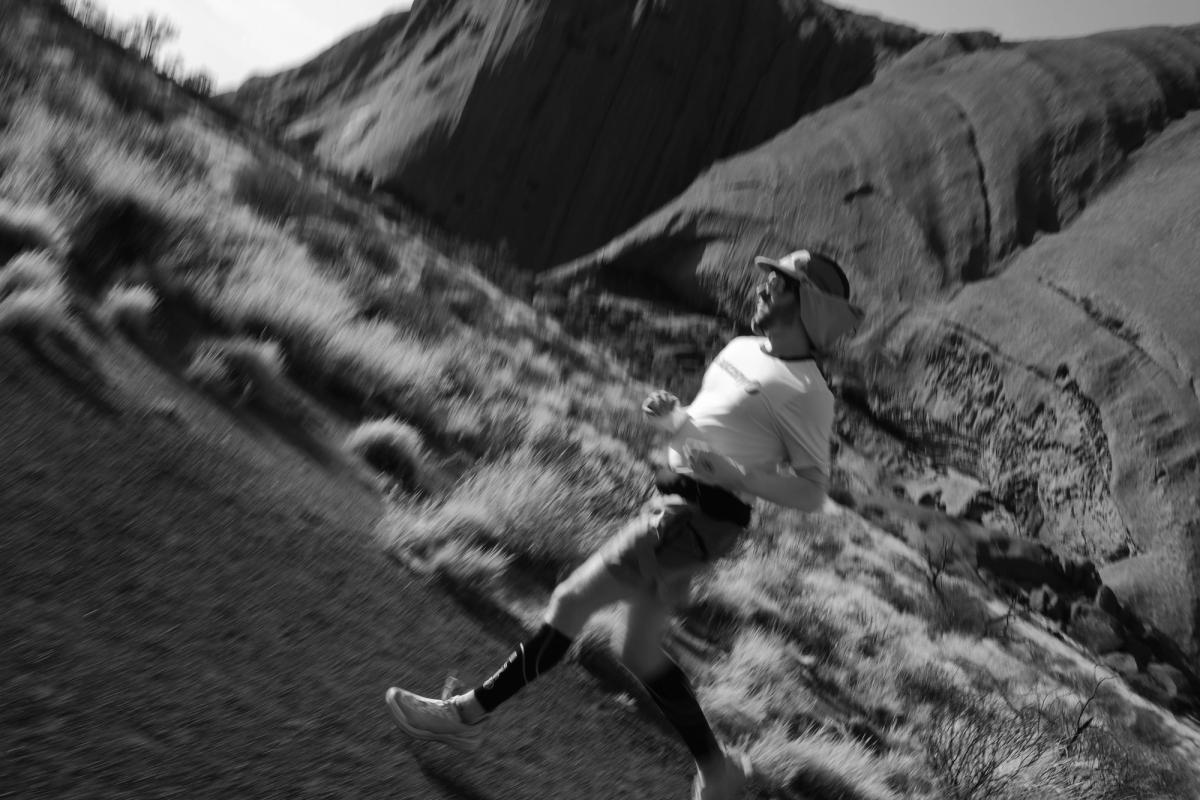
The best run of my life started in the dark. In September 2024, twelve of us drove out to the Mala car park before dawn, waited for enough light to see by, and ran the 10.6km base loop of Uluru as the rock turned from grey to purple to blazing orange. It was OUTRN's first trip. Some ran one lap, two kept going until they had run ten. This guide is everything we learned doing it, and everything you need to run here yourself: the routes, the best times, how to handle outback heat, what to bring, and the practical details that separate a good run from a great one.
This guide covers everything: the running routes, the best times to go, how to prepare for outback heat, what to bring, and the practical details that make the difference between a good run and a great one.
Whether you're planning a self-supported trip or joining a guided running tour, this is the information you need.
Running Routes at Uluru
Uluru Base Walk (10.6km)
The main event. The Uluru Base Walk is a 10.6km loop that circumnavigates the entire rock. It's flat, well-maintained, and fully runnable.
| Detail | Info |
|---|---|
| Distance | 10.6km |
| Elevation gain | Minimal (~20m total) |
| Surface | Compacted dirt, sand, boardwalks |
| Time (running) | 60-90 minutes |
| Time (walking) | 3-4 hours |
| Difficulty | Easy-moderate |
Starting from the Mala Walk car park (the main access point), running clockwise:
Km 0-2: Mala Walk Section
The first section passes the Mala Walk interpretive area: boardwalks, caves, and rock art. Surface is mostly boardwalk and hard-packed dirt. This section has some shade from the rock face.
Km 2-5: Southern Face
The trail opens up. Less shade, more exposure. The surface shifts between compacted red dirt and softer sand sections. This is where the scale of Uluru really hits: you're running along the base of a wall that just keeps going.
Km 5-7: Kuniya Walk Junction
You'll pass the Kuniya Walk junction (a short detour to Mutitjulu Waterhole, worth the 1km addition if you have time). The terrain is similar: firm dirt with sandy patches.
Km 7-9: Eastern Face
This is the sunrise money shot. If you're running clockwise at dawn, you'll be on this section when the light hits. The eastern face is the most photographed angle of Uluru. Plan your pace so you're here when the orange glow peaks.
Km 9-10.6: Return to Mala
The final section completes the loop. Flatter, faster, mostly boardwalk and hardpack.
Mala Walk (2km return)
If you want a shorter option or a warm-up before the full base loop, the Mala Walk is a 2km return trail from the main car park to the Kantju Gorge.
This section includes:
- Aboriginal rock art
- Interpretive signage about Anangu culture
- The Kantju Gorge area (often has water after rain)
It's runnable but better suited for walking: the rock art and cultural information deserve your attention.
Kuniya Walk (1km return)
A short detour off the main base loop leading to Mutitjulu Waterhole, one of the few reliable water sources in the area (though not for drinking).
Worth the extra 1km for the views and the coolness near the water. Good for a mid-run pause.
Best Time to Run at Uluru
Time of Day: Before Sunrise
This is non-negotiable in warmer months and highly recommended year-round.
Start running 30-45 minutes before sunrise. You want to be on the eastern face of the base loop when the light hits. The colour transformation, grey to purple to orange to red, happens fast, and you want to be moving through it, not watching from a viewing platform with 200 tourists.
- May: sunrise ~6:45am, start by 6:00am
- June: sunrise ~7:00am, start by 6:15am
- July: sunrise ~6:50am, start by 6:05am
- August: sunrise ~6:25am, start by 5:40am
- September: sunrise ~5:55am, start by 5:10am
Why not afternoon?
You can run in the afternoon, and sunset has its own appeal. But:
- Temperatures are higher (even in winter, afternoons reach 25-30°C)
- The crowds are larger at sunset viewing areas
- The morning light transformation is more dramatic than sunset
If you're only running once, make it sunrise.
Time of Year: May to September
The Australian outback has two seasons that matter for runners:
Runnable (May–September):
Daytime highs range from 20-28°C. Mornings are cool: sometimes cold (5-10°C at dawn in June/July). Nights can drop near freezing. This is peak season for running and for visitors generally.
Dangerous (October–April):
Daytime temperatures regularly exceed 35-45°C. Ground temperatures can hit 60°C+. Heatstroke risk is real and serious. Parks Australia issues heat warnings and occasionally closes trails.
If you must run in the warmer months:
- Start before 5am
- Finish before 7am
- Carry more water than you think you need
- Tell someone your route and expected return time
- Check Parks Australia warnings before heading out
The recommendation is simple: visit May through September.
Preparing for Outback Conditions
Heat Adaptation
Even in the "cool" months, running at Uluru feels harder than the same distance at home. The combination of heat, dry air, and sun exposure increases your cardiovascular load.
A 2010 study in the Journal of Applied Physiology (Lorenzo and colleagues, 12 trained cyclists) found that a 10-day heat acclimation protocol improved time-trial performance by 6% in cool conditions and 8% in the heat. Two weeks of it before your trip is the single best thing you can do. Our full guide to running in the heat covers the sauna, hot-bath and heat-run protocols in detail.
You don't need a sauna protocol. Practical approaches:
1. Train in the warmest part of the day for 1-2 weeks before your trip. Even 30-40 minute easy runs in afternoon heat help.
2. Add layers during some runs to simulate heat stress. Running in a long-sleeve top when you'd normally wear a singlet works.
3. Treadmill sessions without a fan or in a warm room. Boring but effective.
4. Hot baths after runs (15-20 minutes at 38-40°C) can accelerate adaptation.
The research is clear on this: arriving heat-adapted makes the experience dramatically better. Most runners discover what heat does to their effort on trip day: which is exactly the wrong time to learn it.
Cultural Considerations
Anangu Traditional Owners
Uluru is sacred to the Anangu people, who have lived in this area for over 30,000 years. The national park is jointly managed between Parks Australia and Anangu traditional owners.
Respect means:
- Following photography restrictions. Certain sections of the base walk are marked as no-photography zones. These protect sacred sites.
- Not entering closed areas. Some caves and areas are closed to visitors. Stay on the marked trail.
- Learning the significance. If you can, join a cultural tour or read the interpretive signage. This isn't just a rock: it's a living cultural site.
The Climb (Permanently Closed)
The Uluru climb was permanently closed in October 2019, at the request of Anangu traditional owners.
Nearby Running: Kata Tjuta
Kata Tjuta (the Olgas) is 40km from Uluru, about 45 minutes by car. It's a group of 36 domed rock formations with different terrain and a different feel.
Valley of the Winds (7.4km loop)
The main running route at Kata Tjuta. This trail has actual elevation, around 150m of climbing and descent through gorges and lookout points.
- Distance: 7.4km
- Elevation gain: ~150m
- Surface: rocky dirt, some sand
- Time (running): 45-75 minutes
- Difficulty: moderate
The valley is named for the wind that funnels through the narrow passages: it's constant and strange.
This is more technical than the Uluru base walk: rockier sections, some stairs, more varied terrain. Still very runnable, but watch your footing.
Closes in heat: Parks Australia closes Valley of the Winds when temperatures exceed 36°C (usually by 11am in warmer months). Start early.
Walpa Gorge (2.6km return)
A shorter, easier option. Flat walk into a gorge between two large domes. Good for recovery runs or if you want to add something after Valley of the Winds.
Run Uluru With OUTRN
Want the full experience without the logistics? Our Uluru running adventure includes sunrise base runs, Kata Tjuta Valley of the Winds, Field of Light, Sounds of Silence dinner, and everything handled.
4 days. ~30km of running. Small groups. No race bibs.
Frequently asked questions
Can you run the full way around Uluru?
Yes. The 10.6km Uluru Base Walk is fully runnable with no restrictions on running versus walking. Most runners complete it in 60-90 minutes.
Is running at Uluru safe?
Yes, if you take sensible precautions: run at sunrise, carry enough water (1.5-2L), protect yourself from sun exposure, and tell someone your plans. In extreme heat, trails may close—check Parks Australia warnings.
Do I need a permit to run at Uluru?
No special permit required. The standard $38 park entry pass covers running on all open trails.
What's the best month to run at Uluru?
June-August offer the most comfortable running temperatures (5-10°C at dawn, 20-28°C peak). May and September are also good. Avoid December-February unless you're prepared for extreme heat.
Can I run both Uluru and Kata Tjuta in one day?
Physically yes—they're 40km apart and both open at sunrise. But it's a lot. Most runners prefer separate days to enjoy each location properly.
How does this compare to the Australian Outback Marathon?
The Australian Outback Marathon is a separate annual event (July) using trails around Uluru. The base walk is available year-round and is the main self-supported running option outside the marathon.